Go is not a game of destruction. It is a game of negotiation. It is about controlling at least a little more of the board than your opponent. It is a dialogue on the board.
The goal
You take turns placing stones and use them to surround territory. Territory means empty intersections surrounded only by your own stones. Each of these intersections is worth one point. The stones themselves count for nothing. Whoever has more points at the end wins.
The 5 rules
How a game works
- Black starts. You take turns placing one stone on an empty intersection. Stones never move and have no special abilities.
- Passing and the end of the game. Instead of placing a stone, you may pass. You can place stones again at any time afterwards, for example when you want to answer your opponent’s move. Only when both players pass directly one after the other is the game over.
The struggle for influence
Without these rules, anyone could simply place stones everywhere until the board is full. With them, every stone has to hold its ground. That is what turns placing stones into a game.
- Liberties. The empty intersections directly next to a stone are its liberties. Stones that touch along the lines form a group and share them. A stone or group with zero liberties is captured and removed from the board.
- No suicide. You may not place a stone on an intersection where it immediately has no liberties. The exception is when placing the stone immediately captures opponent stones. First you check what the stone does to the board, and only then what the position on the board does to your stone.
- Ko. You may not make a move that recreates the exact board position of the previous turn. This prevents endless loops.
Everything else in Go follows from these last three rules.
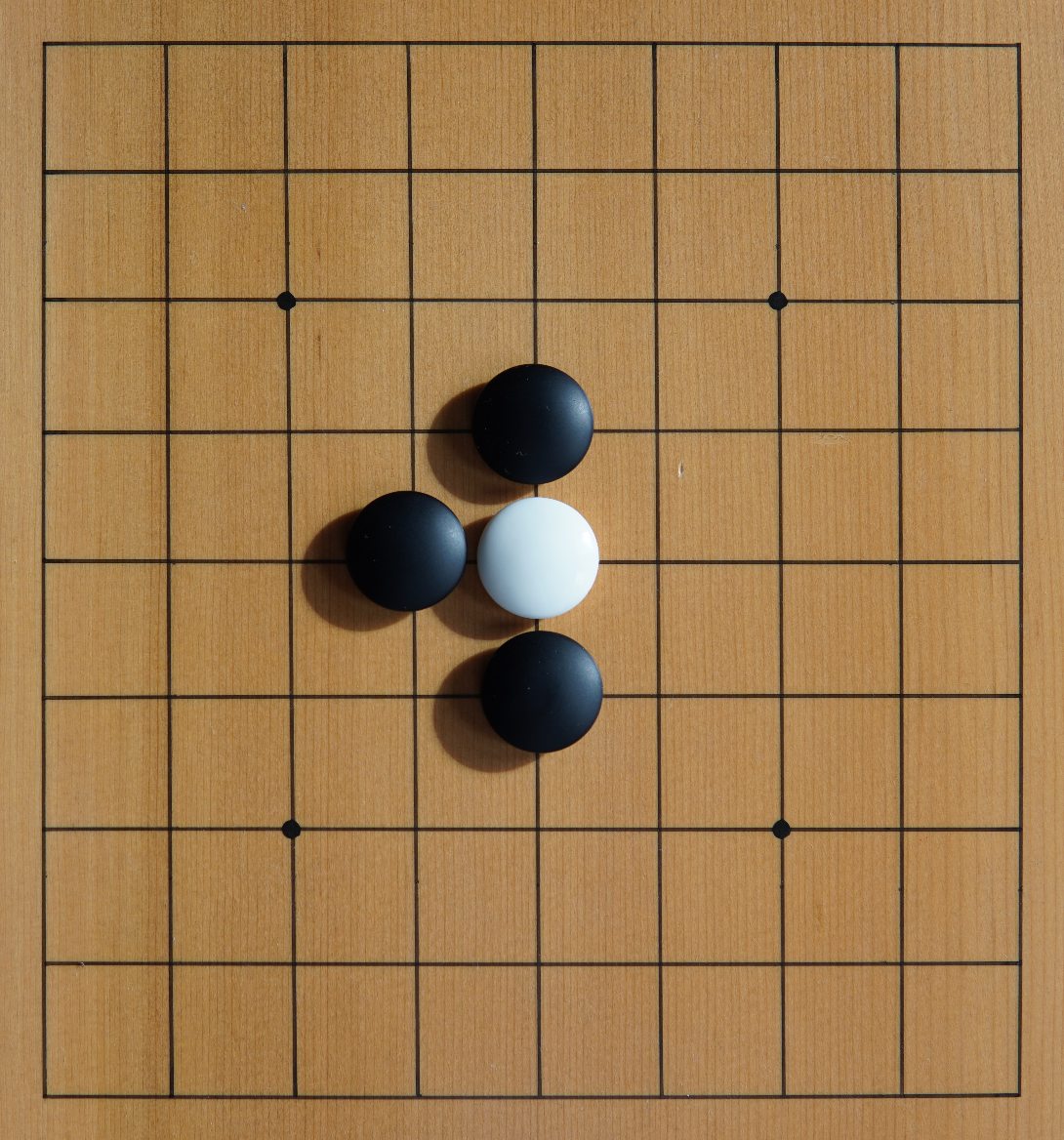
White has one liberty left. If Black plays there, the white stone is captured.
How we count
Captured stones are placed into the opponent’s territory. Then each player counts the empty points in the opponent’s territory. Stones on the board are worth no points. White gets komi (extra points) because Black moved first. Whoever has more points at the end wins. There are no draws.
Handicap
To keep a game balanced, the weaker player gets a handicap. They always play Black and start with extra stones on the board. Komi is reduced to 0.5 points. Then White moves first.
Sounds like a lot? It isn’t. Come to a Go evening. After your first game, it all clicks right away.